TeamGrid
TeamGrid is an AI-native business operating system. Seventeen native apps share one data layer and a company-wide memory, so AI sees the full context of the business — not isolated documents, not stitched-together SaaS — and can act on it the way a senior operator would.
Why a business OS — not another tool.
From an agency frustration to global infrastructure
I founded TeamGrid in 2013 out of a frustration I knew from inside an agency: the day-to-day rarely broke because the work was hard. It broke because the tools couldn’t talk to each other. Every project lived across a calendar, a task tracker, a CRM, a billing tool, and a chat app — and every handoff between them lost context. So instead of stitching another integration on top of the problem, we set out to build the layer that should have existed underneath all of it.
Two years of quiet development followed. We launched in 2015 and were received as #1 Product of the Day on Product Hunt, with more than 200 agencies on the platform within months. The years after that were spent turning early traction into infrastructure customers could plan around — deepening the data model, expanding the surface area, and building a product that companies stayed on for the long run.
In 2022 we relocated headquarters to Dubai. It was a deliberate move into a market that sits at the crossroads of Europe, Asia, and the Middle East — the operating environment a company built to scale globally needs, with the regulatory clarity, talent access, and time-zone reach to match.
The numbers behind the platform
TeamGrid today is not a niche tool. It is operational infrastructure that businesses run on every day, and the numbers reflect that.
By 2020, customers were billing more than one billion US dollars through TeamGrid. By 2025, that number had tripled to over three billion. The platform supports the work of more than 1,600 companies worldwide, from independent agencies to enterprise teams running hundreds of seats. These are not vanity metrics — they describe how much real economic activity has been moving through a single coherent system, year after year, with the reliability that a business depends on for invoicing, planning, and client work.
Why we rebuilt everything in 2023
In 2023 we made a decision that few mature SaaS companies are willing to make: rebuild the entire platform from scratch.
The reason was structural. The whole industry was moving toward AI as a product surface, but the dominant pattern was clearly going to be the wrong one — every incumbent SaaS bolting a chat box, an “Ask AI” button, or a copilot on top of a tool that was never designed to be reasoned over. That approach hits a hard ceiling fast. A model that only sees fragments of a business — a project here, a contact there, an invoice somewhere else — cannot actually understand that business. It can summarise a document. It cannot run an operation.
The lesson from the past two years of agentic AI is now unambiguous: models are only as good as the context they have access to, and context is not a prompt — it is a system. Retrieval over disconnected SaaS, MCP wrappers around legacy APIs, and copilots glued to single-tool surfaces all keep hitting the same wall. The data is fragmented, the schema is inconsistent, the history is scattered, and no amount of prompt engineering compensates for that.
The only honest way to deliver an AI-native experience is to own the data model, the apps, and the runtime they share. So we started over. New data model. New infrastructure. New product. Built quietly over more than two years, with AI not as an addition but as the structural assumption underneath everything.
TeamGrid 2 — one platform, seventeen native apps
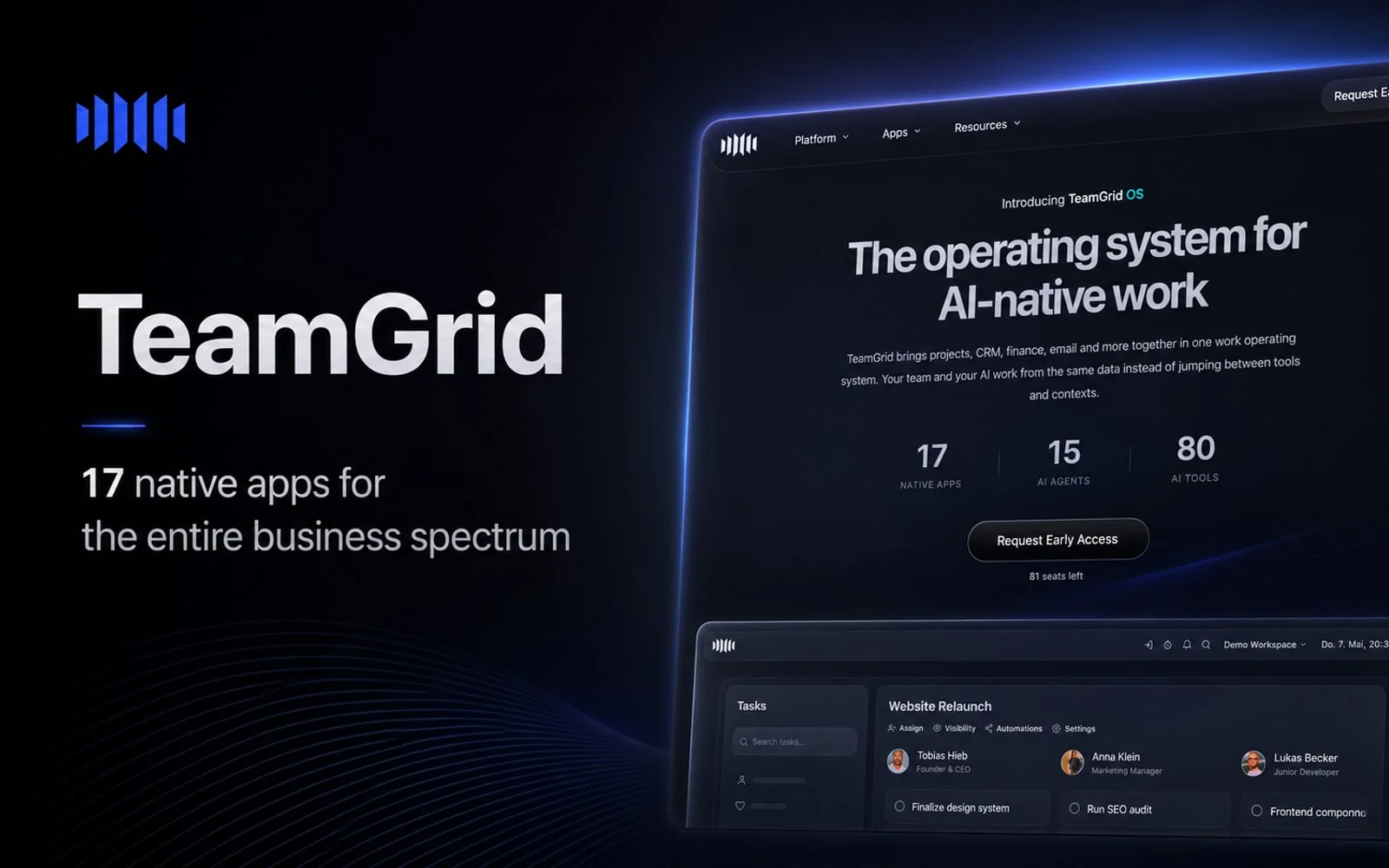
The result is TeamGrid 2 — an AI-native business operating system with seventeen native apps on a single shared data layer: tasks, projects, planning, calendar, contacts, deal pipeline, time tracking, attendance, files, notes, forms, PDF designer, messages, email, billing, analytics, and a workflow builder.
These are not integrations between separate products. They are apps in the same operating system, sharing one model of the business from day one. A task knows the project it belongs to, the client it serves, the contract it bills against, the calendar it competes with, and the conversation it came from — without anyone having to wire that together. The platform is extensible through an App Store, so customers and partners can build on top of the same foundation rather than around it.
This is what changes the AI conversation. Because the system is whole, the AI sees a whole business — not a collection of documents.
The full context of a company, in one system
In TeamGrid, every entity is part of the same graph. Clients, projects, deals, tasks, time entries, invoices, contracts, files, meetings, messages, and emails are not isolated records in separate products — they are nodes in a single, queryable model of the company.
The practical effect is that the platform can answer questions no fragmented SaaS stack can answer honestly. Which clients are unprofitable when you account for unbilled time, scope creep, and the calendar load they create on senior staff? Which deals in the pipeline are stalling because they depend on a delivery team that is already overcommitted? Which projects are about to slip because the owner has been pulled into three other launches? These are not dashboard questions — they are context questions, and they are only answerable when projects, finance, scheduling, CRM, and communication share one data model.
That is the foundation. The AI on top is a consequence of it, not the other way around.
A company memory the AI can actually use
On top of the unified data layer sits a company-wide memory — a persistent, structured layer that captures decisions, commitments, account history, preferences, working agreements, and how the business has handled similar situations before. It is not a vector database tacked onto a chat window. It is part of the operating system itself: every action, document, message, and outcome contributes to a memory the platform can reason over.
This is what most “AI features” in legacy tools are missing. A copilot inside a single product can autocomplete an email or summarise a doc, but it does not remember last quarter’s pricing decision, the SLA we agreed with a specific client three projects ago, or the reason a particular workflow exists. TeamGrid does — because that history was created inside the system in the first place.
The result is an AI experience that compounds: the longer a company runs on TeamGrid, the more valuable its memory becomes, and the more capable the assistant, the agents, and the workflows on top of it get.
AI in the core — chat, voice, and agents
AI in TeamGrid is not a sidebar. It is wired directly into the core of the platform — accessible as chat, voice, and autonomous agents — and it operates on the same shared data layer and memory as every native app.
That changes what AI can actually do. Instead of fetching a document, it can plan a quarter, rebalance workloads across the team, draft a proposal grounded in real account history, run a multi-step sales follow-up, reconcile a billing dispute against the underlying time entries, or trigger a workflow that touches half a dozen apps in one move — all with full awareness of who is involved, what has been agreed, what is in flight, and what has happened before. This is the direction the entire enterprise software market is heading: away from copilots that assist a single tool, toward agentic systems that operate on the whole business. TeamGrid is built for that world from the foundation up.
The thesis
Modern teams do not lose time because their software is too simple. They lose time because they run on twelve disconnected tools that pretend to talk to each other — and now those same tools are bolting AI on top, layering intelligence on a foundation that was never coherent to begin with. The next generation of business software is not a smarter individual tool. It is a coherent system: one foundation, native apps, a company memory, and AI as structure.
That is what we are building TeamGrid into, and that is the conviction I bring to it as Founder and CEO.